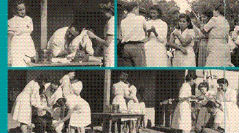
Women made visible, published in the research note section – on researches still in progress (HCSM Jan-Mar 2021) – focuses on the scientific research conducted by women at Portugal’s Institute of Tropical Medicine between 1943 and 1966.
The building where the colonial hospital and the school of tropical medicine were situated in 1902. Source: AMARAL, Isabel. The emergence of tropical medicine in Portugal: The School of Tropical Medicine and the Colonial Hospital of Lisbon (1902-1935). Dynamis [online]. 2008, vol.28 [citado 2021-06-18]The project by João Lourenço Monteiro, doctoral Student at the University of Nova Lisboa, looks at the Institute’s scientific journal to identify the participation of women in tropical medicine during this period. Their publications addressed a variety of subjects and resulted from research carried out in the metropolis as well as Portugal’s overseas colonies.
Most of the articles written by these women were co-authored by their male colleagues, reflecting the incorporation of female researchers into scientific networks already established by men.
This work in progress provides a starting point to lend visibility to a group of scientific actors who are practically absent from the historiography of tropical medicine.
Monteiro, João Lourenço. Women made visible: a different perspective on the history of the Institute of Tropical Medicine in Portugal, 1943-1966. História, Ciências, Saúde-Manguinhos [online]. 2021, v. 28, n. 1 [Accessed 18 June 2021]
Tropical medicine in HCSM:
The Martsinovsky Institute of Medical Parasitology and Tropical Medicine in Moscow Tropical medicine emerged as a specialized field in Europe during the era of colonial expansion. Russia had no colonies in the tropics, but did possess vast territories with hot climates. This review presents the 100-year history of the Martsinovsky Institute of Medical Parasitology and Tropical Medicine in Moscow, Russia.
Chagas disease and tropical medicine in Brazil, 1908-1909 The disease was discovered in 1909 by the Brazilian sanitary physician Carlos Chagas at the Oswaldo Cruz Institute.
Railroads and tropical medicine in Brazil This paper by Jaime Benchimol and André Felipe Cândido da Silva, our former and current science editors, shows how railways supported the development of tropical medicine in the First Republic.
Tropical medicine in occupied Haiti, 1915-1934 This work reflected Haiti’s status as a public health “laboratory” which affected Haitian medicine for years to come and significantly influenced future campaigns aimed at disease eradication.
Luso-tropicalism and its discontents This book reinterprets Gilberto Freyre’s Luso-tropicalist arguments and critically engages with the historical complexity of racial concepts and practices in the Portuguese-speaking world.
Medicine and healing in the colonial Caribbean Adam Warren, professor at Department of History, University of Washington, reviews the book “The experiential Caribbean: creating knowledge and healing in the early modern Atlantic,” by Pablo F. Gómez.
History of women in science – in pictures To celebrate the International’s Women’s Day, The Guardian newspaper published a collection of photos of women in science.
Gender, women and science February, 11 International Day of Women and Girls in Science. This special dossier of HCS-Manguinhos published in 2008 is entirely dedicated to gender, women and science.