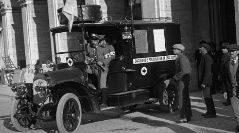



February, 4th 2025, World Cancer Day
The article Physicians, travels, and scientific exchange during the institutionalization of the fight against cancer in Brazil (1941-1945)
article analyzes initiatives taken by physicians from both the private and public sectors who contributed to placing the fight against cancer on the federal government’s agenda of public health policies, which became embodied in the 1941 creation of Brazil’s National Cancer Service. The text also aims to show that this historical process was directly related to the international context of scientific exchange between Brazil and the United States that was encouraged under the Good Neighbor Policy of the 1940s. It calls attention to political disputes over coordinating efforts to fight the disease at the federal level.
The article written by Rômulo de Paula Andrade, Doctoral candidate in the History of the Sciences and Health at Casa de Oswaldo Cruz (COC/Fiocruz) and Vanessa Lana, also highlights the work of two healthcare professionals who, together with surgeon Mário Kroeff, exercised relevant roles in the history of the fight against cancer in Brazil: Antônio Saint Pastous de Freitas, a physician from the state of Rio Grande do Sul, and Antônio Prudente Meireles de Morais, a surgeon from the city of São Paulo. The medical literature cites Kroeff as a central figure in creation of the SNC and as the key protagonist of this historical process. The surgeon did indeed play a vital part in the history narrated here, but our research has identified other people and contexts that likewise figured in the intricate process of institutionalizing services to fight this disease in Brazil.