


November/2013
By Ernesto Spinak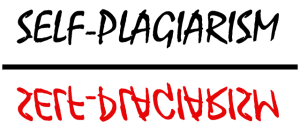 An author is considered to have committed self-plagiarism when he reuses his own previously published material, without making any reference to the earlier published work. In reality, with greater editorial rigor, and depending on the context of the publication and the amount of text that is copied, the inclusion of the slightest reference to it in the newly published work could well not be sufficient because it does not give a clear indication to the reader (nor to the editor for that matter) of the extent of how much is copied.
But … Is it possible for an author to commit self-plagiarism? This sounds somewhat absurd. It is as if a person were to get into his own house through the window and then be accused of robbing it.
From the point of view of author rights, self-plagiarism does not appear to be a crime, but as far as academic integrity is concerned, it is considered to be unethical or even incorrect behavior. This practice is quite current and is found in the list which enumerates the 10 most frequent cases of plagiarism¹. Authors may argue that since these are their own writings, they can use them again and again, in their complete form or as extracts….what is wrong with that?
When do you say self-plagiarism is occurring? What is the boundary between re-suing of one’s own material and self-plagiarism? Does this concept vary in the different academic fields?
In spite of self-plagiarism being a frequent practice and one that is known to the editors of academic journals who are attempting to manage it, it is interesting to note that there are few studies in existence that deal with the problem in a systematic way. A review of the existing literature, taking as sources works that have been published by iThenticate and data bases that specialize in this topic, including Wikipedia², all the works consulted ultimately refer to a small number of original authors who published their findings over 10 or even 15 years ago. One of the most prolific authors is possibly Miguel Roig, who has authored about 70 works on this subject which are indexed in Google Scholar. Some of these have been selected in the compilation of this article and are indicated in the list of references at the end.
A simple definition of self-plagiarism is using a previous piece of one’s own research and presenting it for publication as something new and original. Why would a researcher do such a thing? The academic climate is one of “publish or perish” and the competition for research grants and for being in citation indexes could provide some reasons for this.
Self-plagiarism can be explained for different reasons, and these are not always necessarily unethical. Some can be justified and others fall into a “gray” area which should be resolved by the editor of the publication concerned.
- It is very common for a researcher to have at his disposal a piece of research that was carried out some time ago, but with the addition of new data it may be possible build on the thoughts and conclusions contained therein. This is not necessarily new research, but is the way in which knowledge functions – as new information becomes available this can lead to a re-examination of earlier hypotheses and conclusions.
- Salami publishing is when data gathered by one research project is split up into smaller publishable parts which are sent to different publications and each one of these “slices” repeats an important part of the research in question. It should be noted that a publication can be “salami” without self-plagiarism being committed, but it is unethical on other grounds.
- Journals do not have an explicit policy in their instructions to authors concerning the rules governing self-plagiarism, self-citing, and their policies for specifically dealing with plagiarism. In the particular case of self-plagiarism, it should not be assumed that an author will know these rules by default – they should be clearly stated in the journal’s written policies.
- An author reuses information which appeared in his doctoral thesis, and which was not published in any journals, in an article appearing in another journal in which he makes reference to his thesis. Can this be considered to be self-plagiarism? And what if the situation was the other way around ? He publishes an article in a particular journal, and then reuses the information contained in it in his doctoral thesis. Moreover, there is an additional problem here, that of copyright violation, if it is the case that the journal in which the article was published is not in Open Access and the editor of the journal holds the copyright. However, the situation is not particularly clear in this case because the author could take refuge behind fair use³.
- The previous work is the basis for a new contribution presented in the second work;
- Substantial portions of the previous work need to be repeated to explain the new evidence or to defend new arguments;
- The work addresses other audiences in different places, and it is necessary to make the message understood. For example, an article published in a biotechnology journal that is published later in an economics journal.
- The author considers that what was already said the previous time is explained well enough, so it makes no sense to say it again in a different way in a second publication.
- The MLA Style Manual and Guide to Scholarly Publishing(1998) – the term “self-plagiarism is given superficial treatment.
- The Publication Manual of the American Psychological Association (APA) does not use the term “self-plagiarism” up to and including its 5th edition, and the term recently appears twice in the 6th edition, although the section “Ethics of Scientific Publication” contains a detailed analysis concerning “Duplicate publication of data”.
- The Journal of International Business Studies as well as the Association for Computing Machinery (ACM) have created special policies for the topic.
- The American Political Science Association (APSA) code of ethics describes plagiarism but makes no reference to self-plagiarism.
- The Profesional de la Información (EPI)⁵ does not accept articles whose originality is less than 70%, since at the present time the tendency is for all journals to be more rigorous in accepting works for publication.
- authors should indicate in the submission that the data, revisions or conclusions have already been published in another article, presented at a conference, in a thesis, or on the Internet, and should explain the nature of the previous communication.
- if a study is complex, it should be presented in one comprehensive work and not in different individual works (“salami”).
- avoid extensive citations or paraphrases of key aspects of other works or books, which could also constitute a violation of copyright laws. In the case that this is necessary, they should be consistent with academic conventions of style, such as the use of quotes, editorial and typographic forms to highlight the paraphrasing (font type, indentation, etc.)
- establish a minimum level or originality for a work with respect to previous works. In other words, self-plagiarism should not exceed 20% or 30% of the total of the new work (depending on the subject discipline), and this rule should be part of the instructions for authors explicitly published by journals.
Acknowledgments
I would like to thank Dr. Tomás Baiget, director of “El profesional de la información” (EPI)⁵ for his assistance in reviewing the original text of this article. Any errors that remain are my sole responsibility.Notes
¹ Publication ethics and the problem of plagiarism ² Plagiarism ³ The concept of “fair use” comes from Anglo-Saxon law but its acceptance is varied in countries whose laws are derived from Roman law, also called Civil law. ⁴ Information provided by Thomas Baiget, Editor of EPI. ⁵ El Profesional de la InformaciónReferences
Cross-Disciplinary Studies in Plagiarism. Fabrication and Falsification. Available from: <http://quod.lib.umich.edu/p/plag/>. Ithenticate: 6 Key Takeaways: Self-plagiarism. Available from: <http://cdn2.hubspot.net/hub/92785/file-16016993-pdf/docs/ithenticate-self-plagiarism-6-key-points.pdf>. Ithenticate: The Ethics of Self-plagiarism. Availaible from: <http://www.ithenticate.com/resources/papers/ethics-of-self-plagiarism>. Ithenticate: What Is Self Plagiarism and How to Avoid It. Available from: <http://www.ithenticate.com/plagiarism-detection-blog/bid/65061/What-Is-Self-Plagiarism-and-How-to-Avoid-It>. LUNDSFORD, A. Plagiarism and Intellectual Property in a Postmodern World, State University of New York Press. Prólogo. 1999. Available from: <http://books.google.com.uy/books?hl=en&lr=&id=3OrS-VZ9EcsC&oi=fnd&pg=PR9&dq=Perspectives+on+Plagiarism+and+Intellectual+ Property+in+a+Postmodern+World+&ots=VZeoOws_PT&sig=o529up9En-8-0eF8KK80Q1XVJA#v=onepage&q=Perspectives%20on%20Plagiarism%20and%20Intellectual %20Property%20in%20a%20Postmodern%20World&f=false>. ROIG, M. Plagiarism and self-plagiarism: What every author should know. Biochemia Medica. 2010, vol. 20, nº 3, pp. 295-300. Available from: <http://dx.doi.org/10.11613/BM.2010.037>. ROIG, M. Recycling portions of text from the same author/s previously published papers in psychology: An exploratory study. Paper presented at the second Office of Research Integrity’s conference on Research Integrity, Bethesda,MD. November, 2002. ROIG, M. Re-using text from one’s own previouslypublished papers: An exploratory study ofpotential self-plagiarism. Psychological Reports. 2005, vol. 97, pp. 43-49. Available from: <http://apfei.edu.au/resources/bibliography/re-using-text-ones-own-previously-published-papers-exploratory-study-potentia>. SAMUELSON, P. Self-plagiarism or fair use? Communications of the ACM, 1994, vol. 37, nº 8, pp. 21-5. Available from: <http://people.ischool.berkeley.edu/~pam/papers/SelfPlagiarism.pdf>. SCANLON, P. M. Song from myself: An anatomy of self-plagairism. 2007. Available from: <http://quod.lib.umich.edu/p/plag/5240451.0002.007?rgn=main;view=fulltext>. The Office of Reseach Integrity. Available from: <http://ori.hhs.gov/>. About Ernesto Spinak
Collaborator on the SciELO program, a Systems Engineer with a Bachelor’s degree in Library Science, and a Diploma of Advanced Studies from the Universitat Oberta de Catalunya (Barcelona, Spain) and a Master’s in “Sociedad de la Información” (Information Society) from the same university. Currently has a consulting company that provides services in information projects to 14 government institutions and universities in Uruguay.
Translated from the original in Spanish by Nicholas Cop Consulting.
Source: SciELO in Perspective
How to cite this post [ISO 690/2010]:
Ethical editing practices and the problem of self-plagiarism. SciELO in Perspective. [viewed 14 November 2013]. Available from: http://blog.scielo.org/en/2013/11/11/ethical-editing-practices-and-the-problem-of-self-plagiarism/