



How do scientific ideas circulate between countries? This is one of the questions explored in the new articles published by História, Ciências, Saúde – Manguinhos, recently made available to the public. Bringing together research by authors from different countries, the latest update to volume 33, published at the beginning of this year, examines experiences in Latin America, Africa, Europe, the United States, and Japan to discuss the history of science and health from an international and interdisciplinary perspective.
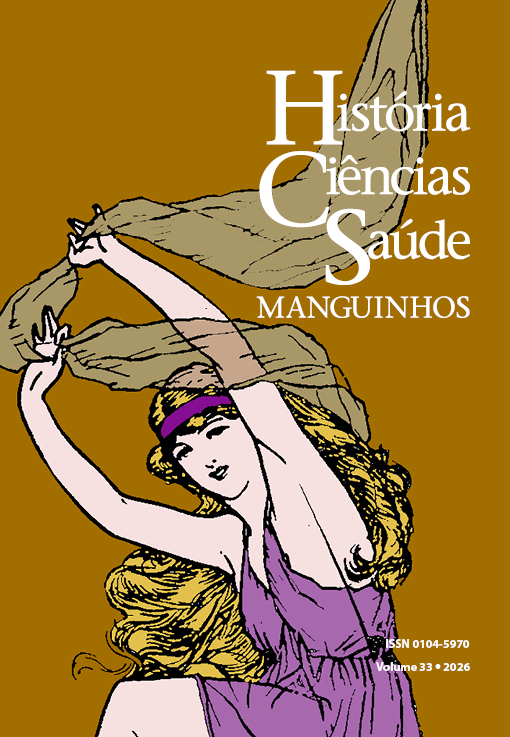
In a jointly signed editors’ letter, Marcos Cueto and Gabriel Lopes announce that Lopes will take over as editor-in-chief after Cueto’s ten-year tenure. The text highlights the new editorial team’s commitment to scientific excellence, open science, internationalization, and the responsible incorporation of emerging challenges such as artificial intelligence.
One of the issue’s main themes is the international circulation of scientific knowledge. The subject appears in different historical contexts, showing how ideas, researchers, and institutions crossed borders and contributed to the development of modern science.
Focusing on early twentieth-century Mexico, an article by Brian Becerra-Bressant and Ana Barahona, from the National Autonomous University of Mexico (UNAM), revisits Andrés Molina Enríquez’s Los grandes problemas nacionales (1909). In Argentina, a study by Nicolás Facundo Rojas, from Conicet, traces the career of Italian physician Silvio Dessy and the creation of the Argentine Biological Institute, showing how scientific research and entrepreneurship went hand in hand in the consolidation of bacteriology. Also addressing the international circulation of knowledge, Adriana Mendonça Cunha, a postdoctoral researcher in the Graduate Program in the History of Science and Health at Casa de Oswaldo Cruz/Fiocruz, analyzes the connections between American educator Robert King Hall’s observations on the national integration of immigrants in Brazil and his proposals for education in postwar Japan.
Public communication of science is another prominent theme. One article by Germana Barata, from Unicamp, and Carolina Ferreira Medeiros, from USP, examines the communication strategies adopted by two of the world’s most influential medical journals: The New England Journal of Medicine and The Lancet.
The social construction of science is also the subject of a study by Jorge M. Escobar Ortiz, from the Metropolitan Institute of Technology. He analyzes Colombian children’s and young adult literature to understand how scientists are portrayed and to discuss the effects of this collective imagery, including its impact on gender inequality.
Also in the Analysis section, José Javier Plumed Domingo, from the University of Valencia, examines changes in Spanish mental medicine between 1870 and 1910, showing how the incorporation of subjectivity and French psychopathology redefined the understanding of the experience of madness.
In Research Notes, a section devoted to ongoing studies, Isabel Casimiro, a lecturer and researcher at the Centro de Estudos Africanos, and Júlio Machele, an assistant lecturer and researcher in the Departamento de História—both at the Faculdade de Letras e Ciências Sociais of Universidade Eduardo Mondlane—analyze leprosy in twentieth-century Mozambique. leprosy in Mozambique during that century.
Reviews of books on the history of science are also available.